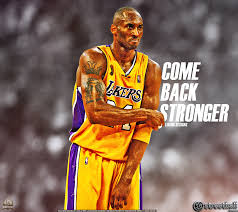
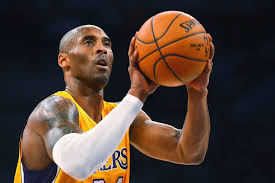
Kobe Bean Bryant (born August 23, 1978) is an American retired professional basketball player and businessman.[3] He played his entire 20-year career with the Los Angeles Lakers of the National Basketball Association (NBA). He entered the NBA directly from high school and won five NBA championships with the Lakers. Bryant is an 18-time All-Star, 15-time member of the All-NBA Team, and 12-time member of the All-Defensive team. He led the NBA in scoring during two seasons, and ranks third on both the league’s all-time regular season scoring and all-time postseason scoring lists. He holds the NBA record for the most seasons playing with one franchise for an entire career.
The son of former NBA player Joe Bryant, Kobe Bryant enjoyed a successful high school basketball career at Lower Merion High School in Pennsylvania, where he was recognized as the top high school basketball player in the country. He declared for the NBA draft upon graduation, and was selected with the 13th overall pick in the 1996 NBA draft by the Charlotte Hornets, who traded him to the Los Angeles Lakers. As a rookie, Bryant earned himself a reputation as a high-flyer and a fan favorite by winning the 1997 Slam Dunk Contest, and he was named an All-Star by his second season. Despite a feud between them, Bryant and Shaquille O’Neal led the Lakers to three consecutive championships from 2000 to 2002.
In 2003, Bryant was accused of sexual assault in Colorado, but the charges were eventually dropped, and a civil suit was settled out of court. After the Lakers lost the 2004 NBA Finals, O’Neal was traded to the Miami Heat. Bryant became the cornerstone of the Lakers, and he led the NBA in scoring during the 2005–06 and 2006–07 seasons. In 2006, he scored a career-high 81 points against the Toronto Raptors, the second most points scored in a single game in league history behindWilt Chamberlain’s 100-point game in 1962. Bryant was awarded the regular season’s Most Valuable Player Award (MVP) in 2008. After losing in the 2008 NBA Finals, he led the Lakers to two consecutive championships in 2009 and 2010, earning theFinals MVP Award on both occasions. He continued to be among the top players in the league through 2013, when the 34-year-old Bryant suffered a torn Achilles tendon. Although he recovered, his play was limited the following two years by season-ending injuries to his knee and shoulder, respectively. Citing his physical decline, he announced that he would be retiring after the 2015–16 season.
At 34 years and 104 days of age, Bryant became the youngest player in league history to reach 30,000 career points. He is also the all-time leading scorer in Lakers franchise history. Following his second year in the league, Bryant was chosen to start every All-Star Game until his retirement for a record 18 consecutive appearances, and his four All-Star MVP Awards are tied for the most in NBA history. At the 2008 and 2012 Summer Olympics, he won gold medals as a member of the U.S. national team. Sporting News and TNT named Bryant the top NBA player of the 2000s.
Early life and education
Bryant was born in Philadelphia, as the youngest of three children and the only son of Joe Bryant and Pamela Cox Bryant.[4]He is also the maternal nephew of basketball player John “Chubby” Cox. His parents named him after the famous beef ofKobe, Japan, which they saw on a restaurant menu.[4] His middle name, Bean, is derived from his father’s nickname “Jellybean”. Bryant was raised Roman Catholic.[5] When Bryant was six, his father left the NBA and moved his family to Rieti in Italy to continue playing professional basketball.[6][7] Bryant became accustomed to his new lifestyle and learned to speak fluent Italian.[7][8] During summers, he would come back to the United States to play in a basketball summer league.[9]
Bryant started playing basketball when he was 3 years old,[10] and his favorite team growing up was the Lakers.[11] Bryant’s grandfather would mail him videos of NBA games, which Bryant would study.[11] At an early age he also learned to play soccer and his favorite team was A.C. Milan.[12] Upon Joe Bryant’s retirement from playing basketball in 1991, the Bryant family moved back to the United States.
High school

Bryant’s retired No.33 jersey and banner at the Lower Merion High School gym.
Bryant earned national recognition during a spectacular high school career at Lower Merion High School located in Ardmore, in the Philadelphia suburb of Lower Merion. As a freshman, he played for the varsity basketball team.[13] He became the first freshman in decades to start for Lower Merion’s varsity team, but the team finished with a 4–20 record.[13][14] The following three years, the Aces compiled a 77–13 record, with Bryant playing all five positions.[13] During his junior year, he averaged 31.1 points, 10.4 rebounds and 5.2 assists and was named Pennsylvania Player of the Year,[15] attracting attention from college recruiters in the process.[15] Duke, Michigan, North Carolina and Villanova were at the top of his list; however, when Kevin Garnett went in the first round of the 1995 NBA draft, he began considering going directly to the pros.[15]
At Adidas ABCD camp, Bryant earned the 1995 senior MVP award,[16] while playing alongside future NBA teammate Lamar Odom.[17] While in high school, then 76ers coach John Lucas invited Bryant to work out and scrimmage with the team, where he played one-on-one with Jerry Stackhouse.[18] In his senior year of high school, Bryant led the Aces to their first state championship in 53 years. During the run, he averaged 30.8 points, 12 rebounds, 6.5 assists, 4.0 steals, and 3.8 blocked shots in leading the Aces to a 31–3 record.[19] Bryant ended his high school career as Southeastern Pennsylvania‘s all-time leading scorer at 2,883 points, surpassing both Wilt Chamberlain and Lionel Simmons.[20]
Bryant received several awards for his performance his senior year including being named Naismith High School Player of the Year, GatoradeMen’s National Basketball Player of the Year, a McDonald’s All-American, and a USA Today All-USA First Team player.[21] Bryant’s varsity coach, Greg Downer, commented that he was “a complete player who dominates” and praised his work ethic, even as the team’s top player.[19][22] In 1996, Bryant took R&B singer Brandy to his senior prom,[23] though the two were, and remain, just friends. Ultimately, however, the 17-year-old Bryant made the decision to go directly into the NBA, only the sixth player in NBA history to do so.[13] Bryant’s news was met with a lot of publicity at a time when prep-to-pro NBA players were not very common (Garnett being the only exception in 20 years).[13] His basketball skills and SAT score of 1080 would have ensured admission to any college he chose,[24]but he did not officially visit any campuses.[22] In 2012, Bryant was honored as one of the 35 Greatest McDonald’s All-Americans.[25]
Professional career
1996 NBA draft
The first guard to ever be taken out of high school, Bryant was chosen as the 13th overall draft pick by the Charlotte Hornets in 1996.[26] According to Arn Tellem, Bryant’s agent at the time, Bryant playing for the Charlotte Hornets was “an impossibility”.[27] However, Bill Branch, the Hornets’ head scout at the time, said that the Hornets agreed to trade their draft selection to the Lakers before picking Bryant. The teams agreed to the trade the day before the draft and the Lakers told the Hornets whom to select five minutes before the pick was made.[28] Branch said that prior to the trade agreement, the Hornets never even considered drafting Bryant. Prior to the draft, Bryant had worked out in Los Angeles, where he scrimmaged against former Lakers players Larry Drew and Michael Cooper and, according to then-Laker manager Jerry West, “marched over these people”.[29] On July 1, 1996, West traded his starting center, Vlade Divac, to the Hornets in exchange for Bryant’s draft rights.[30] Since he was still 17 at the time of the draft, his parents had to cosign his contract with the Lakers until he was able to sign his own when he turned 18 before the season began.[31]
Adjusting to the NBA (1996–1999)
Bryant debuted in the Summer Pro League in Long Beach, California, scoring 25 points in front of a standing-room-only crowd. Defenders struggled to get in front of him, and his performance excited West and Lakers coach Del Harris. He scored 36 points in the finale, and finished with averages of 24.5 points and 5.3 rebounds in four game.[32][33] As a rookie in 1996–97, Bryant mostly came off the bench behind guards Eddie Jones and Nick Van Exel.[34] At the time he became the youngest player ever to play in an NBA game(18 years, 72 days; a record since broken by Jermaine O’Neal and former teammate Andrew Bynum), and also became the youngest NBA starter ever (18 years, 158 days).[35][36]Initially, Bryant played limited minutes, but as the season continued, he began to see some more playing time. By the end of the season, he averaged 15.5 minutes a game. During the All-Star weekend, Bryant participated in the Rookie Challenge and won the 1997 Slam Dunk Contest, becoming the youngest dunk champion ever at the age of 18.[37]Bryant’s performance throughout the year earned him a spot on the NBA All-Rookie Second Team with fellow bench teammate Travis Knight.[38] The Lakers advanced to theWestern Conference semifinals in the playoffs against the Utah Jazz, when Bryant was pressed into a lead role at the end of Game 5. Byron Scott missed the game with a sprained wrist, Robert Horry was ejected for fighting with the Utah’s Jeff Hornacek, and Shaquille O’Neal fouled out with 1:46 remaining in the fourth quarter. Bryant shot four air balls at the end of the game; the Jazz won 98–93 in overtime to eliminate the Lakers 4–1. He first whiffed a game-winning 2-point jump shot in the fourth quarter, and then misfired three three-point field goals in overtime, including two tying shots in the final minute.[39] O’Neal commented that “[Bryant] was the only guy who had the guts at the time to take shots like that.”[40]
In Bryant’s second season, he received more playing time and began to show more of his abilities as a talented young guard. As a result, Bryant’s point averages more than doubled from 7.6 to 15.4 points per game.[41] Bryant would see an increase in minutes when the Lakers “played small”, which would feature Bryant playing small forward alongside the guards he would usually back up.[42] Bryant was the runner-up for the NBA’s Sixth Man of the Year Award,[43] and through fan voting, he also became the youngest NBA All-Star starter in NBA history.[44] He was joined by teammates O’Neal, Van Exel, and Jones, making it the first time since 1983 that four players on the same team were selected to play in the same All-Star Game. Bryant’s 15.4 points per game was the highest of any non-starter in the season.[45]
The 1998–99 season marked Bryant’s emergence as a premier guard in the league. With starting guards Van Exel and Jones traded, Bryant started every game for the lockout-shortened 50-game season. During the season, Bryant signed a 6-year contract extension worth $70 million.[45] This kept him with the Lakers until the end of the 2003–04 season. Even at an early stage of his career, sportswriters were comparing his skills to those of Michael Jordan and Magic Johnson.[31][46][47] The playoff results, however, were no better, as the Lakers were swept by the San Antonio Spurs in the Western Conference Semifinals.[48]
Three-peat (1999–2002)

Bryant was a member of the Lakers teams that won three consecutive NBA Championships from 2000 to 2002.
Bryant’s fortunes would soon change when Phil Jackson became coach for the Los Angeles Lakers in 1999.[49] After years of steady improvement, Bryant became one of the premier shooting guards in the league, earning appearances in the league’s All-NBA,[50] All-Star, and All-Defensive teams.[51] The Los Angeles Lakers became true championship contenders under Bryant and O’Neal, who formed a legendary center-guard combination. Jackson utilized the triangle offense he used to win six championships with the Chicago Bulls, which would help both Bryant and O’Neal rise to the elite class of the NBA. The three resulting championships won consecutively in 2000, 2001, and 2002 further proved such a fact.[52]
Bryant started the 1999–2000 season sidelined for six weeks due to an injury to his hand suffered during a preseason game against theWashington Wizards.[53] With Bryant back and playing over 38 minutes a game, he saw an increase in all statistical categories in the 1999–2000 season. This included leading the team in assists per game and steals per game. The duo of O’Neal and Bryant backed with a strong bench led to the Lakers winning 67 games, tied for fifth-most in NBA history. This followed with O’Neal winning the MVP and Bryant being named to the All-NBA Team Second Team and All-NBA Defensive Team for the first time in his career (the youngest player ever to receive defensive honors).[54] While playing second fiddle to O’Neal in the playoffs, Bryant had some clutch performances including a 25-point, 11 rebound, 7 assist, 4 block game in game 7 of the Western Conference finals against the Portland Trail Blazers.[55] He also threw an alley-oop pass to O’Neal to clinch the game and the series. In the 2000 Finals against the Indiana Pacers, Bryant injured his ankle in the second quarter of Game 2 after landing on the Pacers’Jalen Rose‘s foot. Rose later admitted he placed his foot under Bryant intentionally.[56][57] Bryant did not return to the game, and he also missed Game 3 due to the injury. In Game 4, Bryant scored 22 points in the second half, and led the team to an OT victory as O’Neal fouled out of the game. Bryant scored the winning shot to put the Lakers ahead 120–118.[58] With a 116–111 Game 6 victory, the Lakers won their first championship since 1988.[59]
Statistically, the 2000–01 season saw Bryant perform similarly to the previous year, but he averaged 6 more points a game (28.5). It was also the year when disagreements between Bryant and O’Neal began to surface.[60] Once again he led the team in assists with 5 per game. The Lakers however, only won 56 games, an 11-game drop off from last year. The Lakers would respond by going 15–1 in the playoffs. They easily swept the Portland Trail Blazers, Sacramento Kings, and San Antonio Spurs to advance to the Finals, before losing their first game against the Philadelphia 76ers in OT. They would go on to win the next 4 games and bring their second championship to Los Angeles in as many seasons. During the playoffs, Bryant played heavy minutes which brought his stats up to 29.4 points, 7.3 rebounds, and 6.1 assists per game. In the playoffs, teammate O’Neal declared Bryant the best player in the league.[19][61] Bryant ended up making the All NBA Second team and All NBA Defensive Team for the second year in a row. In addition, he was also voted to start in the NBA All-Star Game for the 3rd year in a row (no game in 1999).
In the 2001–02 season, Bryant played 80 games for the first time in his career. He continued his all-round play by averaging 25.2 points, 5.5 rebounds, and 5.5 assists per game. He also had a career high 46.9% shooting and once again led his team in assists. He claimed his first All-Star MVP trophy after a 31-point performance in Philadelphia, when he was loudly booed by fans as they had throughout the game, stemming from his earlier comment to a 76ers heckler during the Finals that the Lakers were “going to cut your hearts out”.[62][63] While making the All-NBA Defensive team again, he was also promoted to the All-NBA First Team for the first time in his career. The Lakers won 58 games that year and finished second place in the Pacific Division behind in-state rival Sacramento Kings. Bryant was suspended one game after he punched Reggie Miller of the Indiana Pacersafter the Lakers’ March 1, 2002 victory over the Pacers.[64][65]
The road to the Finals would prove a lot tougher than the record run the Lakers had the previous year. While the Lakers swept the Blazers and defeated the Spurs 4–1 in the first two rounds of the playoffs, the Lakers did not have home court advantage against the Sacramento Kings. The series would stretch to 7 games, the first time this happened to the Lakers since the 2000 Western Conference Finals. However, the Lakers were able to beat their division rivals and make their third consecutive NBA Finals appearance. In the2002 Finals against the New Jersey Nets, Bryant averaged 26.8 points, 51.4% shooting, 5.8 rebounds, 5.3 assists per game, which included scoring a quarter of the teams points.[66] At age 23, Bryant became the youngest player to win three championships.[66] Bryant’s play was notable and praised for his performance in the 4th quarter of games, specifically the last 2 rounds of the playoffs.[66][67] This cemented Bryant’s reputation as a “clutch player”.


 TEAM VARSITY